Saturday

Upcoming talks at the Barnes Philosophy Club


BARNES PHILOSOPHY CLUB

A public club that meets to talk with philosophers and discuss a wide variety of philosophical issues. We aim to promote a philosophical and thoughtful approach to everyday life, and to help connect the outside world with the thinking of professional philosophers. We are supported by the Royal Institute of Philosophy and based at the OSO Arts Centre.

To receive our newsletter, get in touch, or book to attend a talk, visit https://www.osoarts.org.uk/philosophyclub or click directly on the talk titles below.


Recordings of some of our recent talks can be viewed on our YouTube channel.


2023 February 14th: Watch our Valentine's Day special talk with Ulrik Lyngs

It was great to see the OSO so busy for our "Valentine's Day Special" last month with Ulrik Lyngs, Carlsberg Foundation Visiting Fellow at the University of Oxford's Human Centred Computing Group. He gave a lively and thought-provoking talk on how we can use a growing range of tools to save ourselves from digital addiction - whether to social media or dating apps - in the face of tech companies' war for our attention. We have a pretty good recording of the talk, which you can watch on YouTube.


You can book on for our next talk with Professor Sophie Grace Chappell, at the OSO website.

Sunday

2022 November: Personal Identity with Andrew Ward


Tuesday, 8 November⋅7:30 – 9:00pm

Andrew explained how the problem of personal identity first arose in the early modern period and then go on to describe how it has been taken up in recent years (largely on the back of the earlier thinkers). The talk brought out sharply contrasting views - some of them - as to what constitutes our identity, not only in the early modern period but, equally, in the present one. Andrew assumed no previous knowledge of the topic.


Andrew Ward was born and lived for his first 25 years in East Sheen. Towards the end of this period, he even became an undistinguished member of the Barnes and Mortlake cricket team. In 1971 he was appointed a lecturer in the Department of Philosophy at the University of York. He is now an honorary lifetime fellow of the department. He has also taught at the University of Florida, Gainesville and, from 2014 to 2017, was visiting professor of philosophy at Shanghai’s University of Finance and Economics. His philosophical papers cover a variety of topics, including scepticism, aesthetics and personal identity. He is the author of Kant: The Three Critiques in Polity Press’s Classic Thinkers series.


Barnes, London SW13 and online


Saturday

10 January 2023: Professor Susan B. Levin: Posthuman Bliss? The Failed Promise of Transhumanism

Register now

Susan B. Levin is Roe/Straut Professor in the Humanities and Professor of Philosophy. The areas of Susan's research are bioethics and ancient Greek philosophy. Her most recent book is Posthuman Bliss? The Failed Promise of Transhumanism (Oxford, 2021). The American Philosophical Association featured the book in its Recently Published Book Spotlight. Levin also discusses the book in a post for OUP blog, an article for the Institute of Art and Ideas, and a blog post in the series “The Page 99 Test.” An interview with her appears in the Summer 2021 issue of the Smith Alumnae Quarterly.

According to a review of Posthuman Bliss? The Failed Promise of Transhumanism in The Hastings Center Report, “Levin offers a comprehensive takedown of the transhumanist project.…Her deeply argued, scientifically informed book shows both that we have good reason to reject transhumanist value assumptions…and that a more robust picture of scientific evidence undermines the feasibility of the transhumanists’ wished-for interventions. Not only are the imagined enhancements unlikely to work in the ways that they imagine, Levin convincingly argues, but even if they did, we would be at risk of losing the very values and capabilities that make humanity worth saving.”


Susan, who is US-based, will be appearing online. To watch at the OSO, and join us for a drink before and/or after the talk, please book a free ticket with the OSO here.

To join us on Zoom, please use the following link to join.

Supported by the Royal Institute of Philosophy.

Sunday

2022 11 October Piers Benn, "Is concern about freedom of expression based on a right-wing fantasy?"

Watch our second talk on freedom of expression, with Piers Benn.

This Tuesday 11 October 2022, 7:30pm at the OSO 

 Supported by the Royal Institute of Philosophy


 Is concern about freedom of expression based on a right-wing fantasy?

In this talk Piers will attempt to do two things. First, he will argue for the importance of free enquiry and free expression within a framework that owes much to J. S. Mill, while considering some genuine difficulties with the ‘Galileo Defence’ of Mill’s conclusions and the often-made claim that much speech is harmful even by Mill’s lights, especially when exercised by the privileged. Second, he will argue against the claim that the limitations on free speech, especially in universities, is a right-wing fantasy. He will concede that boycotts of speakers and angry attacks on opinions are sometimes misrepresented as attacks on freedom of expression but argue that there is nevertheless a fairly serious problem. He proposes a Socratic approach to argument, and the encouragement of opinions diversity in institutions, as part of the solution to this. 

Zoom and online

I'm pleased to say that we seem to have found a solution to our Zoom challenges. The main issue with this recording is the lighting, which we'll work on for next time with Andrew Ward. 

There is no need to register if you'd like to (attempt to) attend the talks online - they should always be accessible via this link.

You can also view past recordings on our YouTube channel.


New season on freedom and identity: Arif Ahmed on Freedom of Speech, 13 September

Many thanks to Professor Arif Ahmed, for a fantastic talk to kick off our opening season. Freedom of speech is perhaps the most basic liberal value, so it's disturbing to hear widespread claims that it is now under threat in liberal democracies like the US and the UK. In this talk I'll state my own view about what freedom of speech is and why it matters, and I'll assess to what extent these threats to it are (a) real and (b) resistible. 


Arif Ahmed is Professor of Philosophy at the University of Cambridge and a Fellow of Gonville and Caius College. His philosophical outlook is individualistic, atheistic, empiricist and liberal (in the old-fashioned sense) and his work applies this approach to questions in metaphysics, the theory of rational choice and philosophy of religion. He has campaigned for many years in defence of free speech and academic freedom and in recognition of this work he was awarded an MBE in the Queen's Birthday Honours 2021 and the Trustees' Award by Index on Censorship.


We hope to have a recording available, though have some technical challenges as ever.


Saturday

Technology and Psychiatry with Dr Yasemin J. Erden Tuesday 14 June 2022

Supported by the Royal Institute of Philosophy


Thank you very much to all those who attended our final talk in the 2021-22 season will be given online by Yasemin J Erden on the theme of technology and psychiatry. The talk contained unpublished material so I'm afraid we were not able to record it.

"Close encounters of the mechanical kind: when clever machines meet problematic theories"

Dr Yasemin J. Erden, Assistant Professor, University of Twente


Monday

10 May 2022 - Dr Reuben Binns on Artificial intelligence and justice

Dr Reuben Binns gave a thoughtful and stimulating lecture on Artificial Intelligence and Justice on 10th May 2022. He discussed various dimensions of justice and how they could be modeled, and explored some of the challenges and limitations of automating these conceptions. He closed by discussing how philosophers could play an important role in examining, and making choices between, different types of justice.


You can read more about Reuben at the University of Oxford's page.


Reuben Binns is an Associate Professor of Human Centred Computing, working between computer science, law, and philosophy, focusing on data protection, machine learning, and the regulation of and by technology. Between 2018-2020, he was a Postdoctoral Research Fellow in AI at the Information Commissioner's Office, addressing AI / ML and data protection. He joined the Department of Computer Science at the University of Oxford as a postdoctoral researcher in 2015. He received his Ph.D. in Web Science from The University of Southampton in 2015.


Supported by the Royal Institute of Philosophy.


Watch: Ray Tallis on Freedom: an impossible reality (April 2022)

The question of free will has preoccupied philosophers for millennia. In recent years the debate has been reinvigorated by the findings of neuroscience and, for some, the notion that we have free will has finally been laid to rest. Not so, says Raymond Tallis. In his quest to reconcile our practical belief in our own agency with our theoretical doubts, Tallis will advance powerful arguments for the reality of freedom. He will challenge the idea that we are imprisoned by laws of nature that wire us into a causally closed world. He will aim to shows that our capacity to discover and exploit these laws is central to understanding the nature of voluntary action and to reconciling free will with our status as material beings.


We had a fantastic talk and discussion with Ray over Zoom, in which he explained his theory of free will very clearly, and engaged with energy and imagination in the discussion afterwards. You can watch our recording and the discussion now:


You can get 25% off Ray's book by using the code AGENDA25 on the publisher's website.

Raymond Tallis trained in medicine at Oxford University and at St Thomas’ Hospital London before becoming Professor of Geriatric Medicine at the University of Manchester. He was elected a Fellow of the Academy of Medical Sciences for his research in clinical neuroscience and he has played a key role in developing guidelines for the care of stroke patients in the UK. From 2011–14 he was Chair of Healthcare Professionals for Assisted Dying. He retired from medicine in 2006 to become a full-time writer. His books have ranged across many subjects – from philosophical anthropology to literary and cultural criticism – but all are characterised by a fascination for the infinite complexity of human lives and the human condition. The Economist’s Intelligent Life magazine lists him as one of the world’s leading polymaths.


Tuesday

Tuesday 8 March 2022: Where should epistemology start? - Professor Timothy Williamson (in person!)

We were delighted that Timothy Williamson, Wykeham Professor of Logic at Oxford since 2000, joined us in person for our next talk on 8th March, 7:15 for a 7:30 start. This provided a great opportunity for members to meet with, and question, one of the country's leading philosophers.

Professor Williamson addressed the fundamental question of epistemology: how can we know things? He talked about why Descartes' "Cogito ergo sum" is a bad starting-point and why the kinds of knowledge humans share with other animals is a better one.

Unfortunately, due to disagreements between Zoom and our mixing desk, the sound recording was not of adequate quality to share. Apologies to those who missed out.

Supported by the Royal Institute of Philosophy.

Timothy Williamson has been the Wykeham Professor of Logic at Oxford since 2000. He was born in Uppsala, Sweden, in 1955. After an undergraduate degree in mathematics and philosophy and a doctorate in philosophy, both at Oxford, he was a lecturer in philosophy at Trinity College Dublin, a fellow and tutor at University College Oxford, and Professor of Logic and Metaphysics at the University of Edinburgh. He has been a visiting professor at MIT and Princeton, a visiting fellow at the Australian National University and the University of Canterbury (New Zealand), a visiting scholar at the centre for advanced study in Oslo, a Nelson distinguished professor at the University of Michigan, Ann Arbor, a Townsend Visitor at Berkeley and Tang Chun-I visiting professor at the Chinese University of Hong Kong. 

Saturday

Watch: 2022 February 8 - Professor Jennifer Lackey on Eyewitness Testimony

In February 2022, we were joined by Jennifer Lackey, the Wayne and Elizabeth Jones Professor of Philosophy at Northwestern University. She gave an impressive and fascinating talk on the  enormous epistemic weight that eyewitness testimony is afforded in the United States criminal legal system and the various forms of injustice that result. We were lucky enough to have several other experts on the topic in the audience, and were able to discuss some of the differences between the US and the UK. You can watch the video here:


Eyewitness testimony is a powerful form of evidence, and this is especially true in the United States criminal legal system. At the same time, eyewitness misidentification is the greatest contributing factor to wrongful convictions proven by DNA testing. In this talk I offer a close examination of this tension between the enormous epistemic weight that eyewitness testimony is afforded in the United States criminal legal system and the fact that there are important questions about its reliability as a source of evidence. I argue that lineups and interrogations often function by way of extracting testimony from an eyewitness through practices that are manipulative, deceptive, or coercive. I then show that when testimony that is extracted in these ways is given an unwarranted excess of credibility, the eyewitness in question is the victim of what I call agential testimonial injustice. I conclude that since much of the testimony of eyewitnesses is both extracted and given an excess of credibility, there is a fairly widespread form of epistemic injustice being inflicted upon testifiers in the United States criminal legal system. This calls for reforms along both dimensions—lineups and interrogations should go through a witness’s epistemic agency, rather than bypassing, exploiting, or undermining it, and the weight of the resulting testimony should be viewed in the broader context of its significant fallibility.

Jennifer Lackey, Wayne and Elizabeth Jones Professor of Philosophy, Northwestern university

Ph.D. Brown University

Jennifer Lackey specializes in epistemology, with a particular emphasis on a broad range of issues in social epistemology. Her recent work focuses on false confessions, the criminal justice system, the duty to object, norms of credibility, the epistemic status of punishment, the epistemology of groups, expertise, and the distribution of epistemic goods.

Sunday

Watch: An Agnostic View of Artificial Consciousness - Tom McClelland, Cambridge University (2022 Jan)

Artificial Intelligence is all around us, but is any of it conscious? If not, might there be conscious AI in the future? Because these questions have major ethical ramifications it's imperative that we find clear answers. However, I argue that no such answers are available. In the absence of an adequate theory of consciousness, we have no way of working out whether an AI is conscious or even whether an AI could be conscious. I explore why we're in this bind and what it means for the ethics of AI.

Watch now:


Tom is a lecturer in the Faculty of Philosophy at the University of Cambridge and a Director of Studies at Selwyn College Cambridge. His research covers a range of topics in philosophy of mind, psychology, metaphysics, aesthetics and the philosophy of business.

Due to ongoing public health concerns and resulting restrictions, Tom appeared over video from Cambridge, with a live audience at the OSO.

Saturday

Watch: Climate denial in a time of policy failure - Dr. Patricia Glazebrook, Washington State University (14 Dec 2021)

Dr. Glazebrook was visiting the UK Washington State University, and provided a philosophical (and at times very practical) analysis of the climate change negotiations at COP 26. Due to last minute venue complications, she ended up giving the talk through a laptop at the Sun Inn in Barnes. For that reason, the sound quality isn't perfect - apologies!


Climate denial in a time of policy failure

This lecture identifies connections between the psychology of climate denial and incapacity of member-states in the UNFCCC to reach an agreement that will prevent the increase of global temperature beyond 1.5oC. First, the U.S. is used as a case study of climate denial among individuals and elected government officials. Next, using COP 26 as an example, conflicting logics are shown to be in play. This conflict is concluded to preclude possibility of a functional agreement. Finally, a common logic is proposed.

Dr Patricia Glazebrook

Tricia Glazebrook is Professor of Philosophy in the School of Politics, Philosophy, and Public Affairs at Washington State University. Her PhD at the University of Toronto uncovered Heidegger’s philosophy of science. She has since applied his work to ecophilosophy, international development, climate change, gender, indigenous knowledge systems, and economics. A primary research area is food security in Africa with particular attention to climate impacts and adaptations by women subsistence farmers in Ghana. She is known as an ecofeminist working for climate justice at the nexus of agriculture, gender, poverty, and climate in the global South. She also works in military ethics with focus on drones and on moral injury as an additional understanding of PTSD, and in ethics of ‘Big Data’ with focus on regulatory systems, policy, industry standards, and specific data applications. In Nigeria, she is a Research Associate at Osun State University and a member of the Board of Governors of the Center for Research in Environment and Sustainable Development in Lagos. She serves on the Board of Directors of Gender CC: Women for Climate Justice that has its international secretariat in Berlin and partners with women’s groups throughout the global South to conduct multiple projects integrating gender into climate policy. She incorporated Ghana Fair in the United States in partnership with the Single Mothers’ Association of the Upper East Region in Ghana to provide livelihood diversification, alternative income, and microcredit financing for women. Current book projects include gendered analysis of climate finance, a textbook on ‘Big Data’ ethics, and an edited volume on Heidegger and gender.

Support the club with a donation and receive a copy of our birthday book: "What counts as philosophy?"

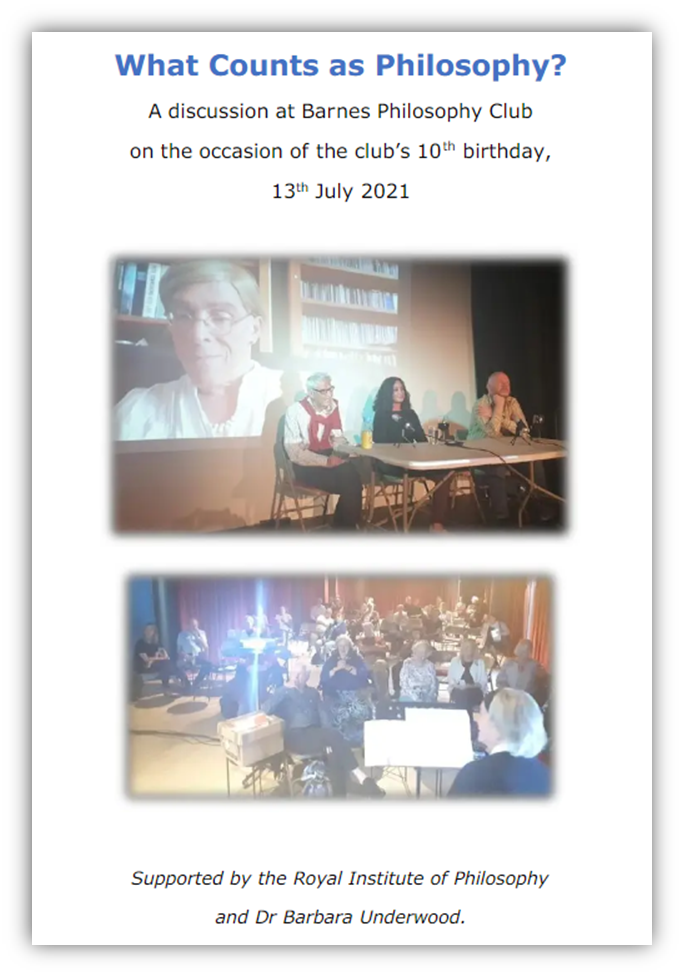
Thank you to everyone who attended our celebration on 13th July, in recognition of the huge achievements of Barbie Underwood, our Chair Emerita in building the Barnes Philosophy Club over a decade. Barbie has organized almost a hundred talks in Barnes, which have brought a fascinating range of ideas and discussions to our community.

We held a panel discussion on the topic of "What counts as philosophy?" with contributions from Andrew Ward, Professor Sophie-Grace Chappell, Richard Ashcroft, Dr Yasemin J Erden, and of course from Barbie herself. 

I'm delighted to say that, thanks to the speakers, we have been able to make the talks available as our first publication. The book also includes a few photos from the club events, and comments from many of you, the club members.


You can view the PDF online at academia.edu and ResearchGate, as well as our website.

I have had a few hard copies printed, and am happy to deliver or post them to anyone who would like to make a small donation to the club towards the costs (any amount welcome). You can do so by clicking the donate button and (after you choose the amount and click Donate) making sure you click the option to "Share your mailing address with Nicholas Aldridge so they can acknowledge your donation".

Support the club

If 'A little learning is a dangerous thing', can too much information be fatal? - Paul Fletcher (9 November 2021)

Tuesday, 9 November, 7:30pm – 9:00pm

Supported by the Royal Institute of Philosophy

With thanks to the OSO Arts Centre


We live in a world reliant upon computers and we can be influenced – coerced – cajoled - persuaded and sometimes feel threatened by technology.  How ought we digest the information embedded within the myriad of ideas and cacophony of opinions we are exposed to in our daily lives?

Watch: Why does Nietzsche say we are strangers to ourselves - Prof Ken Gemes (12 October 2021)

Supported by the Royal Institute of Philosophy and the OSO

Watch now:


Why does Nietzsche say "We are Strangers to Ourselves"?

On the Genealogy of Morals is primarily aimed at gradually bringing us, Nietzsche’s readers, to a potentially shattering realization that in a deep and fundamental sense we do not know ourselves. Nietzsche’s initial assertion in the preface of the Genealogy that his aim is to expose the historical origins of our morality is intentionally misleading and he employs uncanny displacements and subterfuges in order to disguise his real target: we moderns are in fact the ultimate embodiment of the ascetic ideal.

Professor Ken Gemes, Birkbeck University

Ken Gemes received his PhD from the University of Pittsburgh in 1990. He came to Birkbeck in 2000 having taught for ten years at Yale University. He is currently also a Professor at the New College of the Humanities. Thus he has one foot in an institution founded on socialist principles a little less than two centuries ago, the other in an institution belonging in a world of cut-throat capitalism founded a little over two years ago.


10th Anniversary Party on 13th July

Thank you to everyone who attended our celebration on 13th July, in recognition of the huge achievements of Barbie Underwood, our Chair Emerita in building the Barnes Philosophy Club over a decade. Barbie has organized almost a hundred talks in Barnes, which have brought a fascinating range of ideas and discussions to our community.

We held a panel discussion on the topic of "What counts as philosophy?" with contributions from Andrew Ward, Professor Sophie-Grace Chappell, Richard Ashcroft, Dr Yasemin J Erden, and of course from Barbie herself. 

I enclose a letter from Barbie below, and her speech at the event.


A letter from Barbie to the Barnes Philosophy Club

Dear All,

The event on Tuesday evening was smashing. 

I felt extraordinarily moved by the occasion.  It was not just that people said nice things:  but what really moved me was the way everyone put themselves out, either to either turn up, with Andrew from York and Chris from Sheffield, or to go online, as Sophie-Grace and Paul did. 

The gift I received was just amazing -- 'Jazz on a summer's day' has a special place in my heart, plus special champagne -- what more does a girl want?  This was just perfect.

The only downside with these kinds of events is that one wants to spend longer with people.  When, as was the case on Tuesday, there are quite a few people around, you can barely say hello before you have to move on again. 

It has been a privilege to create and sustain the Club (and to manage to keep it free!), and I am so pleased that Nick and the team have taken over.  Of all things philosophy is needed more now than ever.  And this is the context in which the panel discussion on Tuesday was so interesting and enjoyable.   

Richard's talk managed to be succinct, funny and worthwhile at the same time, and certainly started bells ringing!  I enjoyed both Yasemin and Andrew very much as well. The problem as I see it is that when we talk about Philosophy today it seems as if we’ve taken everything out of the cup;  now we have to talk philosophy “of”:  so not just philosophy, but philosophy of something.  I therefore especially liked Sophie-Grace's contribution because she gave us a thread back to the past of western philosophy (let’s make no mistake:  it’s western philosophy that we deal with most of the time:  it would be lovely to have eastern philosophy at some point ...).

I attach a note of my talk beforehand if you want to read it and pass it on to anyone.

Thank you so much to Nick for organising it all, and thanks also to Robin for dealing with the technology -- all very impressive.

Bless you, and thank you so much for all your support.  Long may it last!

Very good wishes for the future.

Barbie

Dr Barbara Underwood


What philosophy has meant to me

by Dr Barbara Underwood

A BIG THANK YOU TO EVERYONE INVOLVED IN ORGANISING THIS EVENT.

            I was just flicking through the latest edition of RIP’s  Philosophy Journal when I spotted Bertrand Russell’s view on the point of philosophy: “to start with something so simple as not to seem worth stating, and to end with something so paradoxical that no one will believe it.”    Slavoj Žižek suggests that philosophy’s job is to ask the right questions.

          Whilst Stephen Hawking was not a philosopher, he said that philosophy is dead (I suppose a pun on Nietzsche’s God is dead) because it does not take sufficient notice of science. I can vouch for this: I was running a junior philosophy club on science, much to the amusement of the juniors, I could not even get a hardboiled egg into the neck of the bottle.

For years I was a session singer with no formal education at all except for music.   Then I came across OU, actually the BBC TV programmes, and thanks to it and the patience of teachers such as Winifred who understood me (actually our relationship was a little like Educating Rita) OU whetted my appetite for Philosophy and at the age of 40 I managed to get into University of York.

Among other teachers  at York, I really enjoyed such lecturers as Roger Woolhouse on the 17th Century, and Richard Francks on Spinoza, But the lectures of Andrew Ward on Kant stood out for me.  Not just his lectures, but his ability to argue with clever students, and he was also a good performer and a joy to watch.  As a performer myself I also appreciated the art of delivery. 

By the way while I was at York I also scored a husband, Simeon, he was working there as an assistant registrar.

After a Masters at King’s College London I continued with a PhD at Manchester. Since then I have always maintained interest in philosophy, doing a couple more courses at OU.

I was too old to start a new career teaching philosophy other than on an ad hoc basis.  But then a truly good friend of mine encouraged me to start a club in Barnes.      

At first I thought that a bit odd - I couldn’t imagine many people being interested in philosophy. But nevertheless a few people turned up at the Methodist church.

I loved the idea of discussing philosophy linking academe with “ordinary people” and ordinary life. Then one day Richard at the Coach & Horses said he would give us a room at the back for free in return for drinks.

I gave all the lectures at first – one day thought I was clever enough to give a potted history of Philosophy and 45 minutes later I had only managed to       reach the beginnings of the Medieval period. But we had a great time as a small group.

 One day Chris Bainbridge came in on my lecture on Kant: an Introduction to his Critique of Pure Reason. As he opened the door he remarked, ‘Blimey - they’re all women!’ However, I realised that I could no longer give all the lectures myself.

Then I remembered Richard Ashcroft and Piers Benn from my days at Imperial. They both very kindly came and gave talks.

Then I wrote to OU and the best thing happened - with Sophie-Grace. Talking as I was just now of performers, she is another one who gives a splendid delivery with very little jargon.  By the way I am working my way, through her work on Epiphanies – I hope it is now a book?

And a real joy for me are the people here at the club the ones who have   contributed (which is what I wanted in the first place) and taken on the task of a talk with enthusiasm: Chris Bainbridge, Nick Aldridge, Robin Strachan, John Madeley, Julia Bebington, Paul Fletcher (who I will come back to in a minute). Even notables such as Philip Collins writer for The Times, Dr Yasemin Erden and a memorable talk by Bishop um ‘thingy’, and last but not least, Simeon Underwood.

I’d also like to mention Julia Bebington because although being extremely enthusiastic on the books I had lent her, she did not want to talk because she had never done it.  I suggested that we did it as an interview and so we rehearsed and rehearsed it.  When the time came she was not only fine but she took to the floor and started engaging, answering the          questions as well.  I am proud of her.  Paul Fletcher is another one to be proud of.  He was encouraged by the club and now has an MA for all his hard work.

Although the club has grown like topsy I have been able to keep the club    free, save buying a drink, without having a formal membership - only a mailing list. All the lecturers gave of their time for free, but I insisted on paying their expenses and if they needed to have a bed and breakfast and suppers we did that too. Members of the club also put people up as          well.

Dear Yasemin had brought the club to the attention of RIP a few years ago: they have started to support us which is absolutely wonderful and has meant we could do a bit more. I feel really proud, not least because it’s usually only universities who get this honour.

I sincerely hope that the club continues in whatever form but an enormous thanks goes to Nick Aldridge for the online work he has managed to do in bringing philosophy to us

So, for me, the purpose of philosophy or what counts as philosophy is, yes, to question, to ask, to seek, to clarify, to deepen thinking at its best.        As Gadamer said, we bring our prejudices to the table.

My view is, the minute we start to think, to form some sort of argument, that’s philosophy.

So let’s not be put off asking questions (particularly the women), or even, like Julia, giving a talk ourselves.

Thank you!


Wednesday

Watch: Kant, free will and moral responsibility - Andrew Ward (11 May 2021)


Supported by the Royal Institute of Philosophy

Can we be held responsible for our actions if they couldn't have been otherwise? Kant seeks to defend moral freedom - the freedom required for moral responsibility to make sense - while insisting that it must be possible to accept determinism: that every event is caused to occur by preceding events and factors. Andrew explores Kant's attempted solution, and considers why it has been treated so uncharitably by other philosophers.

Andrew undertook his BA at Exeter before coming to York as a lecturer and then an honorary life fellow of the Department of Philosophy. His research interests are in Hume and Kant, personal identity, and aesthetics. Before then, he lived in East Sheen for 24 years!

Watch the talk

Tuesday

Truth in the Biomedical Sciences - Andreas Bikfalvi (April 2021)

View the video online


The notion of truth has been debated extensively by philosophers and scientists alike for centuries. Relativist and absolutist/objectivist philosophies have a complete different understanding of the value attached to this notion. In this presentation, I will discuss a number of issues related to the notion of truth in the biomedical sciences. I will first lay out different meanings and forms of truth and then discuss how this relates to the notion of causality. I will then describe how the biomedical science produces "truth" and lay down the different ways to achieve this (induction, causal inference, falsification, Baysian approach, etc..).  


I will then illustrate this by citing examples from the medical history and present-day biomedical research related to infectious disease, vascular biology and cancer research. I will then show that a strong relativist epistemology is incompatible with the way biomedical science obtains knowledge. Thus, in my view, a realistic notion of truth is central to achieve a sound understanding of physiology and pathology, and for the development of therapies grounded in a correct knowledge of disease. 

Friday

How Should One Live? Ancient tragedy and modern philosophy - Prof Sue Mendus (March 2021)


View the video online

"In his 1985 book, Ethics and the Limits of Philosophy, Bernard Williams claims that the
central question of moral philosophy is ‘How Should One Live?’. If that is indeed the central question, then where should we look for an answer? Many modern philosophers deny that ‘the ancients’ especially the ancient Greek poets and tragedians – can give us much help: our lives are so different from theirs that they cannot illuminate our predicament. Or so it is said. In this talk, I will dispute that claim and try to show how ancient tragedy can inform modern philosophy."