Saturday

Watch: 2022 February 8 - Professor Jennifer Lackey on Eyewitness Testimony

In February 2022, we were joined by Jennifer Lackey, the Wayne and Elizabeth Jones Professor of Philosophy at Northwestern University. She gave an impressive and fascinating talk on the  enormous epistemic weight that eyewitness testimony is afforded in the United States criminal legal system and the various forms of injustice that result. We were lucky enough to have several other experts on the topic in the audience, and were able to discuss some of the differences between the US and the UK. You can watch the video here:


Eyewitness testimony is a powerful form of evidence, and this is especially true in the United States criminal legal system. At the same time, eyewitness misidentification is the greatest contributing factor to wrongful convictions proven by DNA testing. In this talk I offer a close examination of this tension between the enormous epistemic weight that eyewitness testimony is afforded in the United States criminal legal system and the fact that there are important questions about its reliability as a source of evidence. I argue that lineups and interrogations often function by way of extracting testimony from an eyewitness through practices that are manipulative, deceptive, or coercive. I then show that when testimony that is extracted in these ways is given an unwarranted excess of credibility, the eyewitness in question is the victim of what I call agential testimonial injustice. I conclude that since much of the testimony of eyewitnesses is both extracted and given an excess of credibility, there is a fairly widespread form of epistemic injustice being inflicted upon testifiers in the United States criminal legal system. This calls for reforms along both dimensions—lineups and interrogations should go through a witness’s epistemic agency, rather than bypassing, exploiting, or undermining it, and the weight of the resulting testimony should be viewed in the broader context of its significant fallibility.

Jennifer Lackey, Wayne and Elizabeth Jones Professor of Philosophy, Northwestern university

Ph.D. Brown University

Jennifer Lackey specializes in epistemology, with a particular emphasis on a broad range of issues in social epistemology. Her recent work focuses on false confessions, the criminal justice system, the duty to object, norms of credibility, the epistemic status of punishment, the epistemology of groups, expertise, and the distribution of epistemic goods.

Sunday

Watch: An Agnostic View of Artificial Consciousness - Tom McClelland, Cambridge University (2022 Jan)

Artificial Intelligence is all around us, but is any of it conscious? If not, might there be conscious AI in the future? Because these questions have major ethical ramifications it's imperative that we find clear answers. However, I argue that no such answers are available. In the absence of an adequate theory of consciousness, we have no way of working out whether an AI is conscious or even whether an AI could be conscious. I explore why we're in this bind and what it means for the ethics of AI.

Watch now:


Tom is a lecturer in the Faculty of Philosophy at the University of Cambridge and a Director of Studies at Selwyn College Cambridge. His research covers a range of topics in philosophy of mind, psychology, metaphysics, aesthetics and the philosophy of business.

Due to ongoing public health concerns and resulting restrictions, Tom appeared over video from Cambridge, with a live audience at the OSO.

Saturday

Watch: Climate denial in a time of policy failure - Dr. Patricia Glazebrook, Washington State University (14 Dec 2021)

Dr. Glazebrook was visiting the UK Washington State University, and provided a philosophical (and at times very practical) analysis of the climate change negotiations at COP 26. Due to last minute venue complications, she ended up giving the talk through a laptop at the Sun Inn in Barnes. For that reason, the sound quality isn't perfect - apologies!


Climate denial in a time of policy failure

This lecture identifies connections between the psychology of climate denial and incapacity of member-states in the UNFCCC to reach an agreement that will prevent the increase of global temperature beyond 1.5oC. First, the U.S. is used as a case study of climate denial among individuals and elected government officials. Next, using COP 26 as an example, conflicting logics are shown to be in play. This conflict is concluded to preclude possibility of a functional agreement. Finally, a common logic is proposed.

Dr Patricia Glazebrook

Tricia Glazebrook is Professor of Philosophy in the School of Politics, Philosophy, and Public Affairs at Washington State University. Her PhD at the University of Toronto uncovered Heidegger’s philosophy of science. She has since applied his work to ecophilosophy, international development, climate change, gender, indigenous knowledge systems, and economics. A primary research area is food security in Africa with particular attention to climate impacts and adaptations by women subsistence farmers in Ghana. She is known as an ecofeminist working for climate justice at the nexus of agriculture, gender, poverty, and climate in the global South. She also works in military ethics with focus on drones and on moral injury as an additional understanding of PTSD, and in ethics of ‘Big Data’ with focus on regulatory systems, policy, industry standards, and specific data applications. In Nigeria, she is a Research Associate at Osun State University and a member of the Board of Governors of the Center for Research in Environment and Sustainable Development in Lagos. She serves on the Board of Directors of Gender CC: Women for Climate Justice that has its international secretariat in Berlin and partners with women’s groups throughout the global South to conduct multiple projects integrating gender into climate policy. She incorporated Ghana Fair in the United States in partnership with the Single Mothers’ Association of the Upper East Region in Ghana to provide livelihood diversification, alternative income, and microcredit financing for women. Current book projects include gendered analysis of climate finance, a textbook on ‘Big Data’ ethics, and an edited volume on Heidegger and gender.

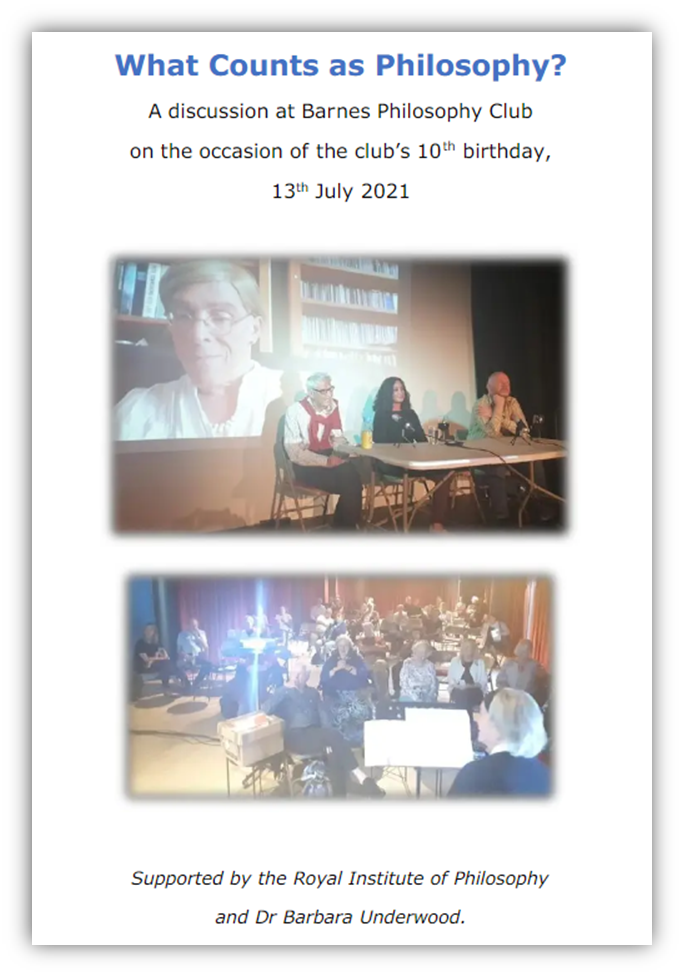
Support the club with a donation and receive a copy of our birthday book: "What counts as philosophy?"

Thank you to everyone who attended our celebration on 13th July, in recognition of the huge achievements of Barbie Underwood, our Chair Emerita in building the Barnes Philosophy Club over a decade. Barbie has organized almost a hundred talks in Barnes, which have brought a fascinating range of ideas and discussions to our community.

We held a panel discussion on the topic of "What counts as philosophy?" with contributions from Andrew Ward, Professor Sophie-Grace Chappell, Richard Ashcroft, Dr Yasemin J Erden, and of course from Barbie herself. 

I'm delighted to say that, thanks to the speakers, we have been able to make the talks available as our first publication. The book also includes a few photos from the club events, and comments from many of you, the club members.


You can view the PDF online at academia.edu and ResearchGate, as well as our website.

I have had a few hard copies printed, and am happy to deliver or post them to anyone who would like to make a small donation to the club towards the costs (any amount welcome). You can do so by clicking the donate button and (after you choose the amount and click Donate) making sure you click the option to "Share your mailing address with Nicholas Aldridge so they can acknowledge your donation".

Support the club

If 'A little learning is a dangerous thing', can too much information be fatal? - Paul Fletcher (9 November 2021)

Tuesday, 9 November, 7:30pm – 9:00pm

Supported by the Royal Institute of Philosophy

With thanks to the OSO Arts Centre


We live in a world reliant upon computers and we can be influenced – coerced – cajoled - persuaded and sometimes feel threatened by technology.  How ought we digest the information embedded within the myriad of ideas and cacophony of opinions we are exposed to in our daily lives?